
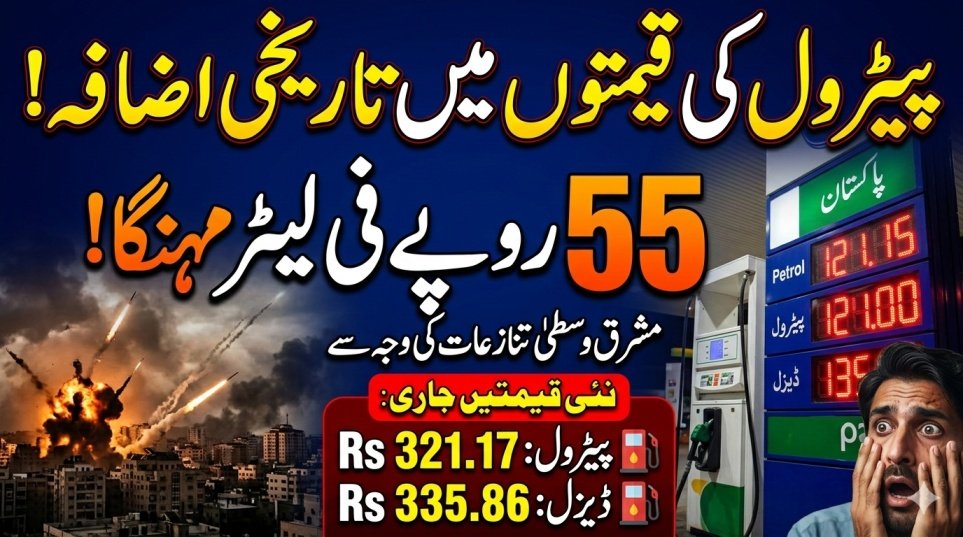
The government of Pakistan has announced a major increase in petroleum prices due to rising tensions in the Middle East. Officials say the global oil market has been heavily affected by the ongoing conflict in the region, which has pushed crude oil prices higher.
During a joint press conference, Deputy Prime Minister Ishaq Dar, Finance Minister Muhammad Aurangzeb, and Petroleum Minister Ali Pervaiz Malik confirmed the decision. According to the announcement, both petrol and high-speed diesel prices have been increased by Rs 55 per liter across the country.
The new prices came into effect at midnight, and the government said the decision was taken due to extraordinary global circumstances.
| Fuel Type | New Price |
|---|---|
| Petrol | Rs 321.17 per liter |
| High Speed Diesel | Rs 335.86 per liter |
| Price Increase | Rs 55 per liter |
| Implementation Time | Midnight |
| Reason | Middle East tensions |
| Announcement | Government Press Conference |
Petrol Price Increase in Pakistan After Middle East Conflict
The petrol price increase in Pakistan has been directly linked to rising crude oil prices in international markets. The conflict in the Middle East has disrupted supply routes and created uncertainty in global energy markets.
Government officials explained that global oil prices are rising quickly, and Pakistan must adjust its prices to manage the economic impact.
Key factors behind the increase include:
• Rising global crude oil prices
• Conflict and instability in the Middle East
• Pressure on Pakistan’s fuel imports
• Weak currency exchange conditions
• Rising transportation and shipping costs
Officials said the situation is being monitored daily, and further decisions will depend on global developments.

Government Explanation for the Fuel Price Hike
During the press conference, Deputy Prime Minister Ishaq Dar explained that the government had to make a difficult decision because the region is currently facing war-like conditions.
According to officials:
• The Middle East conflict has affected the global oil supply
• Oil prices are increasing rapidly in international markets
• Pakistan imports a large portion of its petroleum needs
• The government tried to balance the economic burden
• Authorities are reviewing the situation every day
The government also confirmed that the Prime Minister personally reviewed the situation before the decision was announced.

Changes in Petroleum Development Levy (PDL)
Along with the price increase, the government also adjusted the Petroleum Development Levy (PDL) on fuel.
The changes include:
• Petrol PDL increased from Rs 84.40 to Rs 105 per liter
• Diesel PDL reduced from Rs 76.21 to Rs 55 per liter
• Levy changes were made to balance the impact on consumers
• The government aims to manage revenue through taxation adjustments
• These changes are part of the broader fuel pricing strategy
Officials said such adjustments are necessary to maintain economic stability during global crises.
| Policy Change | Details |
|---|---|
| Petrol PDL | Increased to Rs 105 |
| Diesel PDL | Reduced to Rs 55 |
| Policy Goal | Balance economic pressure |
| Government Review | Weekly monitoring |
| Market Factor | Global oil prices |
| Adjustment Reason | Regional conflict |

Government Monitoring Global Situation
Petroleum Minister Ali Pervaiz Malik said Pakistan is currently facing unusual global circumstances. The conflict in nearby regions has created uncertainty in energy markets.
He stated that the government had already taken steps to secure fuel supplies before the crisis worsened.
Important government actions include:
• Increasing national fuel reserves
• Monitoring international oil markets daily
• Contacting friendly countries for support
• Managing supply routes and imports
• Reviewing fuel prices on a weekly basis
The minister emphasized that the government is trying to handle the situation carefully to avoid fuel shortages.
Possible Relief If Situation Improves
The government has also assured the public that fuel prices could decrease if the global situation improves.
Officials said:
• Fuel prices will be reviewed regularly
• Reductions may be announced if oil prices fall
• The government wants to protect consumers
• Regional peace could stabilize oil markets
• Quick action will be taken if conditions improve
This means the current price increase may not remain permanent if global markets stabilize.
Conclusion
The petrol price increase in Pakistan by Rs 55 per liter reflects the serious impact of rising global oil prices caused by tensions in the Middle East. With petrol now priced at Rs 321.17 and diesel at Rs 335.86 per liter, the government says the decision was unavoidable due to extraordinary circumstances.
Officials have promised to closely monitor the global situation and review prices regularly. If international oil markets stabilize and regional tensions decrease, the government may reduce fuel prices again in the future.
FAQ
1. How much did petrol prices increase in Pakistan?
Petrol prices increased by Rs 55 per liter according to the latest government announcement.
2. What is the new petrol price in Pakistan?
The new petrol price is Rs 321.17 per liter.
3. Why did petrol prices increase?
Prices increased due to rising global oil prices and tensions in the Middle East.
4. Can petrol prices decrease again?
Yes, the government said prices may decrease if global oil prices fall and the regional situation improves.
Latest Updates
 Fuel Subsidy for Motorcycles Sindh 2026 Eligibility via SMS
 Fuel Subsidy for Motorcycles Pakistan 2026 Eligibility via SMS
 Today Update: Kuwait Announces Monthly Allowance for Single Women – 2026 Social Welfare Update
 Today Update: Punjab Fake E‑Challan SMS Scam Alert 2026 — How to Protect Yourself Online
 Latest Update: How To Apply Online For Himmat Card 2026 – Complete & Updated Guide
 Latest Update: Step-by-Step Guide to Register a Complaint via Helpline 1000
 Latest Update: Punjab Class 9 Exam Date Sheet 2026 – Full Schedule Announced
 Latest Update: 8171 Web Portal Balance Check by CNIC 2026 – Complete Guide